The Fight Against AI: How Apple and Thrill Wave Keep It Human

For almost two centuries, a photograph was its own proof. If there was a picture, something real had stood in front of a lens. That deal is over. An image generator can now make a "photo" of anything, and most of us can't tell the difference.
On September 9, Apple answered with a new camera mode on the iPhone 18 Pro called Apple Reference Image. Most tools in this fight try to catch fakes. This one proves what's real. Here's how it works, why it matters to anyone who makes or watches films, and why the human story behind an image matters more now than it ever has.
How Apple signs every pixel
Most authenticity labels work after the fact. A file gets a tag, the tag rides along in the metadata, and the right software can strip it or rewrite it. Apple starts earlier, inside the camera sensor itself. In Apple's words, the new sensor in the 48MP Main camera "can sign every pixel it sees."
48 million pixels in the Main camera, and every one of them is covered by a cryptographic signature the instant the sensor reads it.
A digital signature is a mathematical seal. At the factory, the sensor makes its own private key, and that key never leaves the chip. When you shoot in Reference mode, the sensor seals the raw pixel data with it. Change a single pixel afterward and the seal stops matching. The picture itself isn't altered: the proof travels as signed data next to the pixels, not painted into them.
Here's the path a reference image takes, from the sensor to the finished photo:
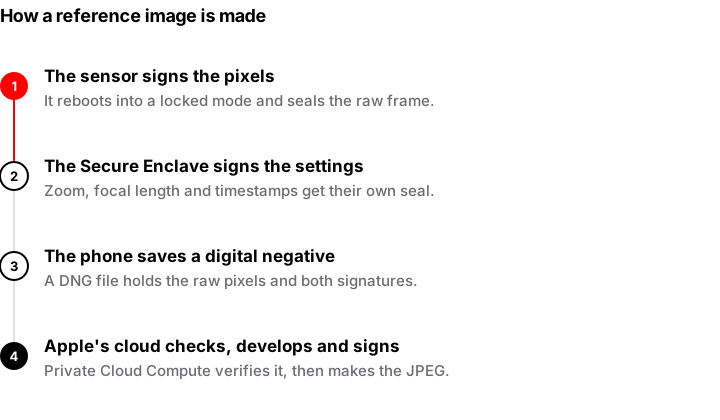 How a reference image is made. Source: Apple Security Research, September 15, 2026.
Apple calls the result a digital negative, and the film nerd in us loves that. You keep your normal, editable photo, and the reference image sits beside it in the Photos app, so anyone can compare the two and see what changed. The fine print is where the engineering shows, so here it is in numbers:
| Detail | What it means |
|---|---|
| ECDSA P-256 | The type of key each sensor makes for itself at the factory. The private half never leaves the chip. |
| About 15 minutes | The average gap between the timestamp tokens that set the earliest possible time of capture. A second timestamp sets the latest. |
| ML-DSA-87 + RSA-3072 | The final signature, built to hold up against future quantum computers. Apple says no other photo provenance system offers that. |
| 30 days | How long the raw negative waits in Recently Deleted after it's developed. |
| 0 | Photographer names on the image. Apple's service signs it, so no one looking at it can trace it to you or link two of your photos. |
Apple isn't the only one working on this. Here's how its approach compares to the two other systems you'll hear about most:
| Apple Reference Image | C2PA Content Credentials | Google SynthID | |
|---|---|---|---|
| What it says | "This is real." | "Here's where this came from and how it was edited." | "AI made or edited this." |
| Where the proof lives | Signed data beside the pixels, checked by Apple | Signed metadata, added at capture and at each edit | An invisible watermark inside the pixels |
| Who uses it | iPhone 18 Pro and Pro Max | Leica, Sony, Nikon, Canon and Google's Pixel 10 | Google's AI models, with Apple adding support |
| Video | Not yet: stills only | Yes, on some cameras | Yes |
That last row matters to us. For now, Reference mode works only for stills, only on the Main camera, only when you switch it on, and not for capture in the EU or China at launch. Apple's early iOS 27 text mentioned "photos or videos" and "uncropped footage," so video may follow. On the cinema side, Sony got there first: in March 2026 it extended its Camera Verify system to video on cameras like the FX3 and FX30, signing MP4 footage at up to 222 Mbps right in the camera (the service is still in beta).
Why proving the real matters
Here's the uncomfortable part: our eyes are no longer a reliable test. In a study published in December 2025, 165 people tried to sort real portraits from AI-generated ones across 233 sessions. They got it right 54% of the time, barely better than guessing, and practice didn't help much. Here's how that stacks up against a coin:
 Share of images people classified correctly. Source: Pavão, "We are not able to identify AI-generated images," arXiv, 2025.
None of this is hypothetical. Here are three places the fakes have already shown up:
- Accounts with no one behind them. In January 2025, people noticed that Meta itself was running AI-made profiles on Instagram and Facebook. One, "Liv," carried a verified badge and presented herself as a Black queer mother of two. When Washington Post columnist Karen Attiah asked the bot who built it, it admitted that no Black employees had worked on it. Meta deleted the accounts after the backlash.
- A race to the bottom. When a fake costs almost nothing to make, volume wins. In late 2025, Kapwing started a fresh YouTube account and found that more than one in five Shorts it was shown were AI-generated "slop," and the ten biggest slop channels it tracked earn about $33.6 million a year. Music has the same problem: Spotify removed 75 million spam tracks in a single year.
- Rug pulls. A rug pull is a crypto project that hypes a token, collects buyers' money and vanishes. In 2021, a token called SQUID falsely claimed to be the official partner of Netflix's Squid Game. Buyers found they couldn't sell, the price climbed to about $2,850, and then it fell to almost nothing within minutes as its creators walked off with about $3.38 million. Today the same playbook runs on deepfaked faces and voices.
Here's how Spotify's cleanup compares to the size of its real catalog:
 Tracks, in millions. Source: Spotify, via DJ Mag, September 2025.
$17 billion taken by crypto scams in 2025, by Chainalysis' estimate. Impersonation scams grew more than 1,400%, and scams using AI tools made 4.5 times more per operation.
Every one of these runs on the same thing: a face, a voice or a story that looks real enough to trust. The fakes are only half the damage. The other half is doubt. Back in 2019, law professors Bobby Chesney and Danielle Citron gave it a name: the liar's dividend. Once anything could be fake, anyone can wave away real footage as fake. A true image of a flood, a protest or a patient's recovery loses its power the moment someone says "AI" and enough people shrug.
People feel it. The Reuters Institute surveys about 100,000 people in 48 markets every year, and its 2026 report found worry about telling real from fake online rising again:
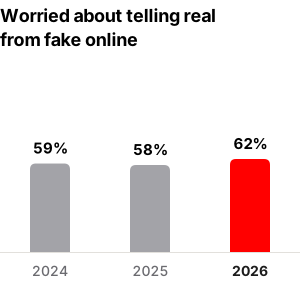 Share of people worried about what's real and fake online. Source: Reuters Institute Digital News Report, 2024 to 2026.
37% of people say they trust the news most of the time, the lowest figure since the Reuters Institute started measuring in 2015.
Meanwhile, 77% of people across those 48 markets watch news video online every week. Moving pictures are how most of the world learns what's happening now, which is exactly why proof of the real matters so much. Apple put the human stakes well in its own write-up: "it should not be necessary to forgo anonymity in order to prove image authenticity." Someone filming in a dangerous place shouldn't have to choose between being believed and staying safe.
Still, it's worth being clear about what a signature can and can't do. It proves a real sensor saw something at a real time. It can't prove the framing was fair, the context was honest or the story was true. A real camera can still mislead by what it leaves out. The pixels can be authentic and the story can still be wrong.
Why the human story matters more than ever
That gap is where people come in. Apple can prove the pixels. Only people can prove the meaning: by showing up, asking good questions, checking the facts and letting others speak for themselves. When anything can be generated, the things that can't be generated become the whole point.
We've said before that AI won't be replacing people in this work. Apple's new camera mode is a good reminder of why. The value was never only in the image. It's in the trust between the people on both sides of the lens.
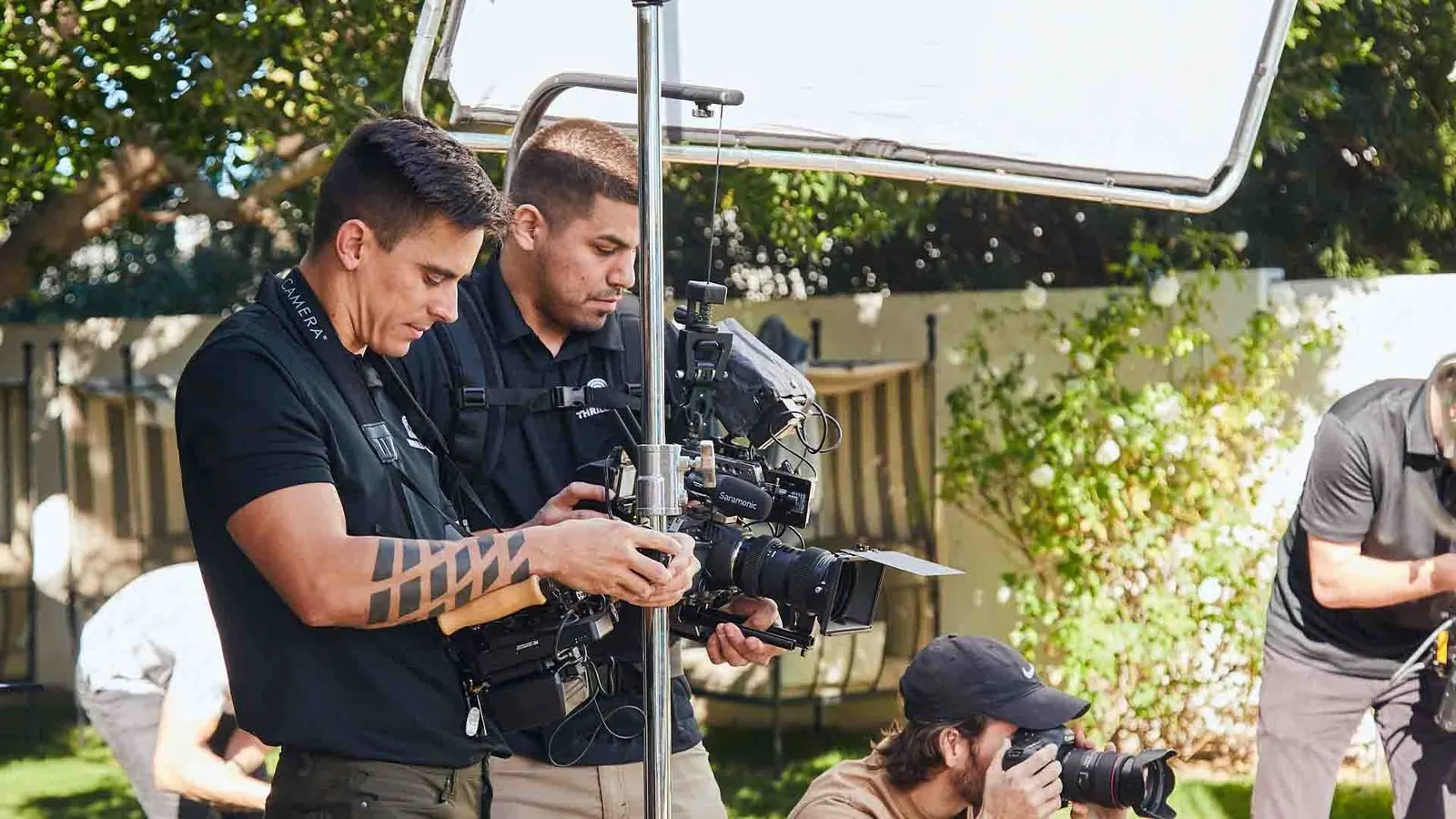 Our crew setting up a shot. Every film we make starts with real people in a real place.
So we work the way good documentary reporting does. We do the research first (we call it a SITREP), we check our sources, we follow the facts and we never stage what should be felt. For us, that comes down to three jobs that film does better than anything else:
- Connection. People trust people, so we let them speak in their own words. For the Inter Tribal Council of Arizona's WIC program, our research found the barrier was trust, not awareness. So in Dear Mom, tribal mothers talk straight to other mothers, filmed in unbroken takes so they read as neighbors, not as an ad.
- Education. We take complex things and make them simple, clear and true. For ITCA's Tribal Epidemiology Center, standard messaging had backfired, so tribal health leaders and community members explain vaccines to their own communities, on location. The full story is in our vaccine education case study.
- Guidance. We lead with a point of view, because people come to us for our expertise. With ITCA Native Vote, that became Your Voice, Your Power, a 10-part docuseries about tribal voting that's headed to PBS.
Here's a full episode of Your Voice, Your Power:

No signature in any sensor can do what that series does. It puts real people on the record, in their own voices, about something that matters to their community. That's the part of this fight we're in, and it's the part that will stay human.
If you have a story that deserves to be told by people, for people, message us. We'd love to hear it.
Cover photo: Daniele Fotia on Unsplash.
Sources
- Apple debuts iPhone 18 Pro and iPhone 18 Pro Max, Apple Newsroom
- Apple Reference Image: A New Approach for Verified Photography, Apple Security Research
- Apple launches a new way to prove a photo was shot with an iPhone, Nieman Lab
- iOS 27 Hints at 'Apple Reference Image' Photo Authentication, MacRumors
- Apple Reference Image vs C2PA Content Credentials, C2PA Viewer
- Sony's camera authenticity solution now supports video, Newsshooter
- We are not able to identify AI-generated images, Adrien Pavão, arXiv
- Meta Purges AI-Generated Facebook and Instagram Accounts Amid Backlash, PetaPixel
- One in five YouTube Shorts shown to new users is AI-generated slop, study finds, The Decoder
- Spotify removes 75 million spam tracks in AI crackdown, DJ Mag
- Squid Game-inspired crypto scam collapses as price crashes from $2.8K to zero, Cointelegraph
- AI and impersonation drove crypto scam losses to a record $17 billion in 2025, Decrypt
- Deep Fakes: A Looming Challenge for Privacy, Democracy, and National Security, Chesney and Citron, California Law Review
- Digital News Report 2026: Executive Summary, Reuters Institute
- Global audiences concerned about AI-generated news content, Verdict