How to Film Public Health Stories With Tribal Communities

Most public health films are built to reach as many people as possible. A film for a tribal community has a harder job first: it has to be believed. A message about vaccines, nutrition or voting can be accurate, well shot and still land badly if it sounds like one more outsider telling people what to do.
We've spent a lot of time on this question with the Inter Tribal Council of Arizona, making WIC nutrition films, vaccine education for its Tribal Epidemiology Center and a docuseries on tribal voting. Here's what we've learned about who should speak, what to sort out before anyone rolls, and how to shoot it.
Start with the gap, not the message
Public health numbers for Native communities often point to a real gap, and it's tempting to make a film that simply repeats the right answer louder. The CDC's own report on flu inequities shows the size of the problem: from 2009 to 2022, American Indian and Alaska Native adults were hospitalized with flu at a rate about 30% higher than White adults, and fewer got vaccinated.
30% higher flu hospitalization rate for American Indian and Alaska Native adults than for White adults, 2009 to 2022, per the CDC.
Here's how vaccination looked by group in the 2021 to 2022 season:
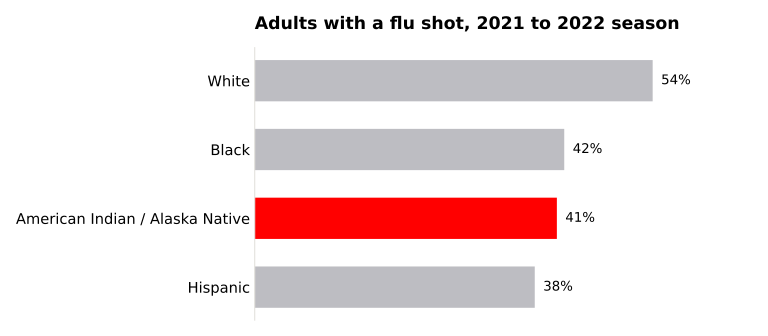 Share of adults vaccinated against flu, 2021 to 2022 season. Source: CDC Vital Signs.
A chart like this tells you there's a gap. It doesn't tell you why. That's what our research (we call it a SITREP) is for. For ITCA's WIC program, the research showed that many tribal members linked WIC with government surveillance. The barrier wasn't awareness, it was trust, and a louder awareness film would have made things worse.
Let the community speak for itself
The CDC report makes the same point from the other side: it names partnerships with community organizations and "trusted messengers" as a way to raise vaccination rates. On film, that means the person on camera matters more than the script.
So we leave out the narrator. In Dear Mom, tribal mothers talk straight to camera to other mothers, with no institutional voice and no one telling anyone what to do. We shot them in unbroken takes so they read as neighbors, not as a cut-together ad. Here's the film:

For the Tribal Epidemiology Center, standard messaging had already backfired. So tribal health directors and community members explain the vaccines in their own words, filmed on location in their own communities. The full story is in our vaccine education case study. This is one of the films:

A few things make this approach work on the day. We plan interviews around the speaker's comfort, not our shot list. We let people answer in their own order and at their own pace, because a rushed answer sounds rehearsed. And when a speaker is more comfortable in their own language, that's a strength of the film, not a problem to solve in the edit.
Every nation sets its own rules
Arizona is home to 22 federally recognized tribes, and the Inter Tribal Council of Arizona has 21 member tribes. Each is a sovereign government, and each decides what can be filmed, where and by whom. There's no single permit that covers "tribal land", so the rules for one community tell you nothing about the next.
22 federally recognized tribes in Arizona, each with its own government and its own say over cameras on its land.
Two examples show how much they vary. The Hopi Cultural Preservation Office asks visitors not to record anything in and around Hopi villages: no photos, video, audio, sketching or even note taking, and especially not during ceremonies. The Navajo Nation's parks department requires a permit for commercial filming in its tribal parks and prohibits drones in the parks and across the Navajo Nation.
Here's what we sort out before a shoot day, and why:
| Before you film | Why it matters |
|---|---|
| Who approves the film, and who signs off on the final cut | The tribe or program, not the crew, decides how its people are shown. |
| Which places can and can't be filmed | Some sites, buildings and ceremonies are off limits, even in the background. |
| Whether a permit is needed, and for drones | Rules differ by nation, and some ban drones outright. |
| Consent from every person on camera | People should know where the film will play before they agree. |
| Who owns the footage and the stories | Communities have good reason to care where their images end up. |
| Where the film will play | Clinics, community events, tribal media and social each need a different cut. |
That last question about ownership has a name in research circles. The CARE Principles for Indigenous Data Governance, published in 2020, set out four ideas: collective benefit, authority to control, responsibility and ethics. They were written for data, but they're a good gut check for footage too. Ask whether the film benefits the community, whether the community controls how it's used, and whether you'd be comfortable explaining every choice to the people in it.
Shoot where people live and work
The best setting for a health film in a tribal community is usually the one people already trust: the clinic, the community center, the kitchen table, the land around it. We film where people live and work, and we ask before we point a camera at anything. That covers the obvious things, like a sacred site, and the easy-to-miss ones, like a mural, a family photo on the wall or a child walking through the frame.
It also helps to keep the gear out of the way. Quiet lights, a tidy setup and a crew that knows when to step back make it easier for people to be themselves. The goal is a film where the community recognizes itself, not a film where it recognizes a production.
If you run a tribal health or community program
If you're planning a film about a health program, a service or a vote, start with the question this post started with: what's keeping people from acting, and who would they believe? The answer usually shapes everything else, from who speaks to where it plays. You can see more of the work we've made with tribal communities on our Tribal Nations page, and if you'd like to talk through your story, message us. We're happy to think it through with you.
Sources
- Flu Vaccination Inequities (Vital Signs), Centers for Disease Control and Prevention
- About ITCA, Inter Tribal Council of Arizona
- Arizona's Federally Recognized Tribes, Arizona Department of Education
- Visitor Etiquette, Hopi Cultural Preservation Office
- Commercial Film and Photography Permits, Navajo Nation Parks and Recreation
- CARE Principles for Indigenous Data Governance, Imperial College London (summary of Carroll et al., 2020)